Tilt-panel or steel-frame: which is right for your warehouse?
Building systems · Updated · 6 min read
Short answer
Choose steel-frame when you want an economical, easily extended building with openings anywhere; choose tilt-panel (tilt-up concrete) when you need fire-rated or boundary walls, security, durability or acoustic mass, and the site has room for casting and a crane. In Rider Levett Bucknall's 2026 Brisbane benchmark, a 4,500 m² industrial building costs $1,360 to $1,800 per m² with metal cladding and $1,460 to $1,960 per m² with precast concrete cladding. Many buildings combine both: steel frames with concrete lower walls.
Side by side
| Consideration | Steel portal frame, metal clad | Tilt-panel (tilt-up concrete) |
|---|---|---|
| Brisbane benchmark, 4,500 m² (RLB, Q4 2025, excl. GST) | $1,360–$1,800 per m² | $1,460–$1,960 per m² (precast cladding) |
| Fire separation / boundary walls | Needs added fire-rated construction | Concrete walls can provide fire-rated separation |
| Security and impact resistance | Lower | Higher |
| Extending later | Straightforward: add bays | Possible, planned around panel layout |
| Site needs | Space to lay down and erect steel | Casting space on slab or bed, crane access and standing area |
| Openings | Anywhere, easy to change | Set before casting |
How tilt-up works
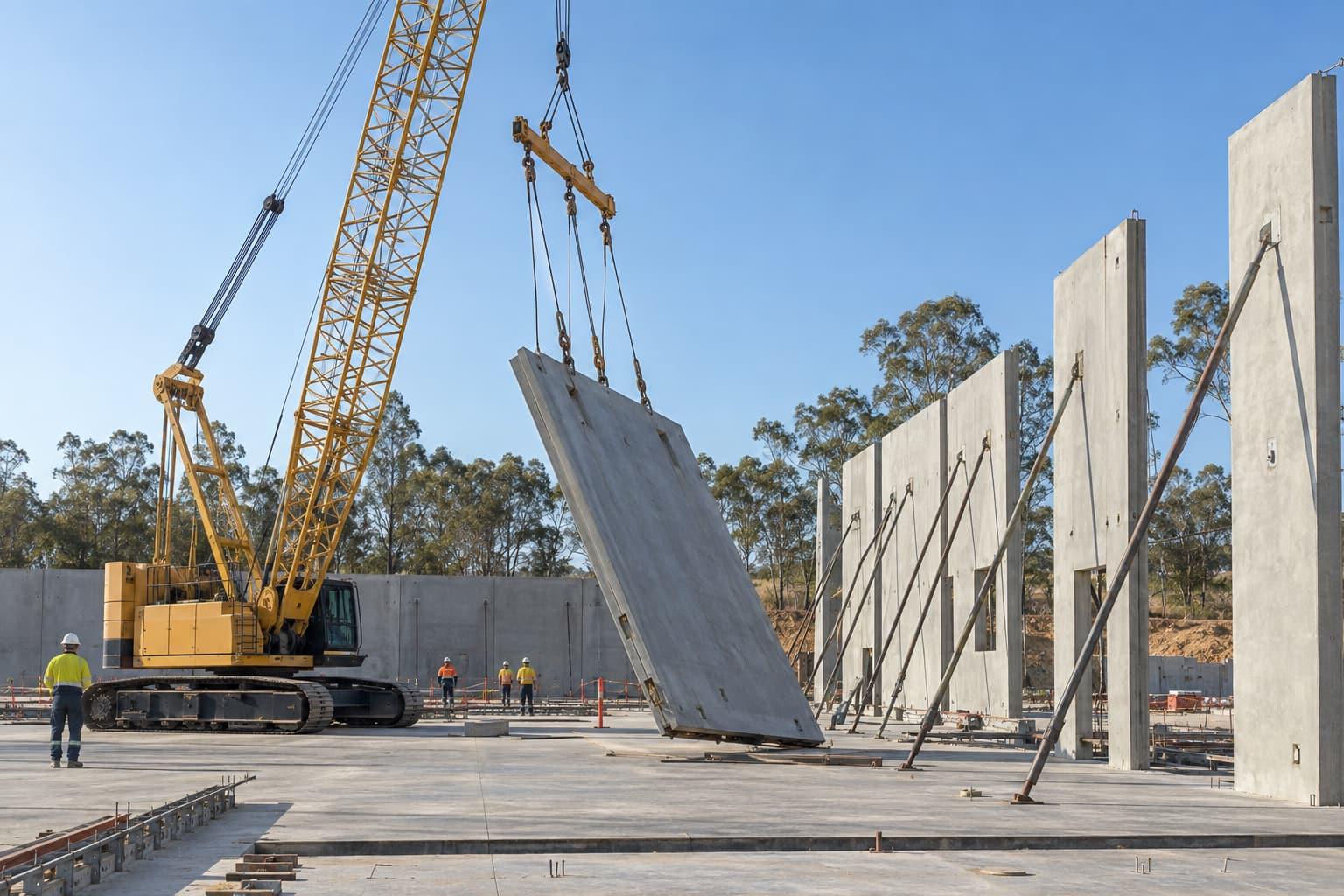
Panels are cast flat on site, usually on the building slab, then lifted upright by crane and temporarily braced until the roof ties them in. Queensland's Tilt-up and pre-cast construction Code of Practice 2003 governs the work, and where the crane stands on the casting bed the builder should have an engineer verify the bed can take the loads.
Are tilt-up panels load-bearing?
They can be. Panels can be designed to carry the roof or to act as cladding on a steel frame. The engineer decides this for each project.
A common hybrid
A steel portal frame with concrete panels or blockwork to a set height gives impact resistance and fire separation where it matters and keeps the flexibility of steel above. We price the options side by side at concept stage.